
Beauregard's Missing Third Day
The official Beauregard Parish Sheriff's Office product is a rolling 48-hour released roster. No BPSO page labeled as a 72-hour release list was found. As a result, the online view can answer only the newest two days of a three-day inquiry. The oldest 24-hour slice is absent once its cards roll off. A defensible 72-hour result pairs visible cards with a BPSO release log requested for a precise interval.
This limitation matters most after a long weekend. On Monday afternoon, an event from Friday morning may already be outside the public display even though it belongs within the user's chosen three-day period. A court docket may show a dismissal, bond order, sentence, or time-served entry. It still cannot reconstruct each jail processing time. Likewise, an archive mirror or third-party roster is not official retention and should not fill the gap.
Online display and legal record retention are different. BPSO intentionally removes cards from the convenience view after its stated span, but that does not establish when the underlying jail-management record is destroyed. Louisiana R.S. 44:36 supplies a general three-year minimum when no more specific law or approved schedule applies. It also permits approved retention schedules. Ask BPSO which schedule controls booking logs, release logs, and photographs rather than treating the general rule as a guaranteed retention term for every record.
The official roster chooser states the window plainly. Its captured label is the basis for keeping the online and requested portions separate.
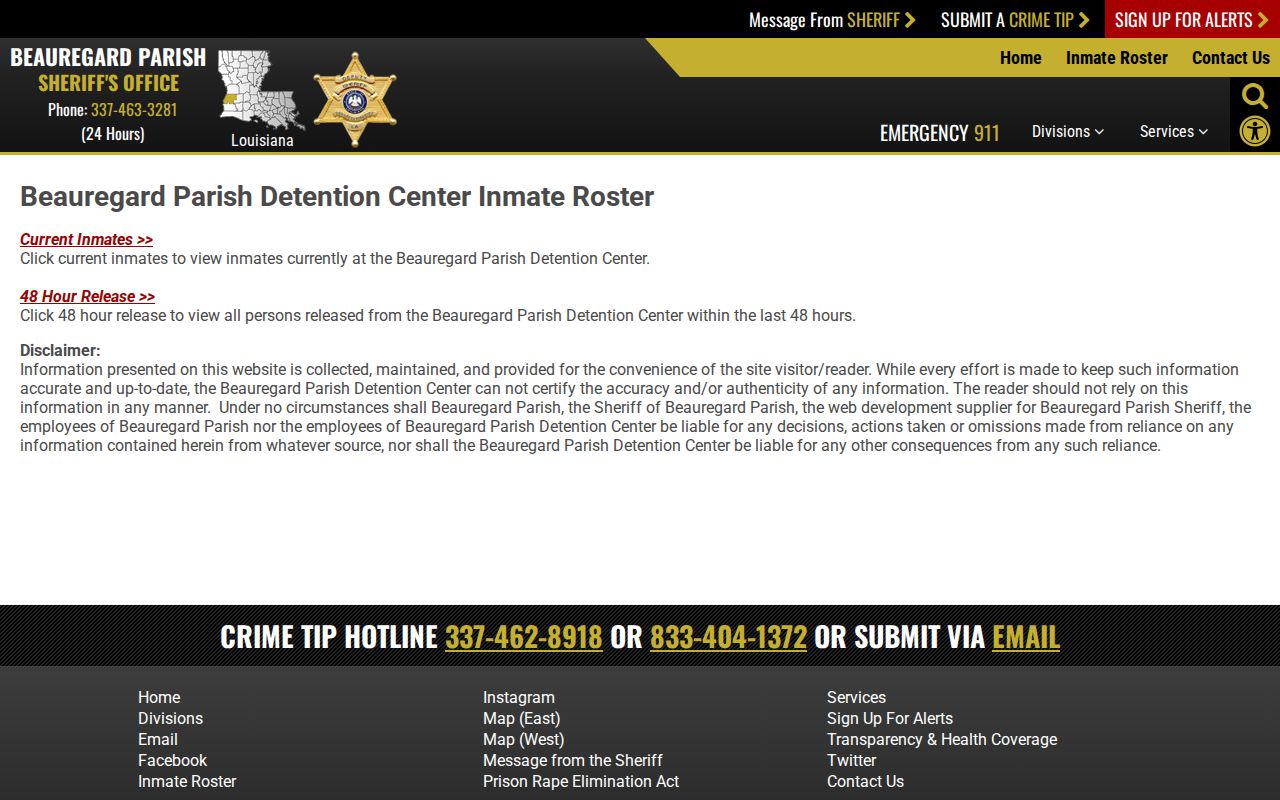
The screenshot confirms the short public window. It does not state how long BPSO retains the underlying booking and release log.
Build Beauregard 72-Hour Releases
Define the interval before searching. A rolling period needs a start timestamp, end timestamp, and time zone. Calendar-day labels are too loose, especially around midnight. Then gather the newest 48 hours from the sheriff feed and request the earlier slice from the jail. A request for the entire 72-hour release log can be simpler when exact completeness matters because it keeps all events in one agency-produced record.
- Set the exact beginning and end of the three-day period, including the local time zone.
- Open the BPSO released feed and record the page-access time before copying visible timestamps.
- Match each visible card by booking number, name, photo, booking date, and charges.
- Ask BPSO for the release log covering the missing first day, or the full fixed interval.
- Merge records by booking number and release time, then remove duplicates without changing agency wording.
- Confirm the release mechanism and receiving authority when the public card does not show them.
A narrow request can ask for existing records sufficient to show full name, booking number, actual release date and time, release mechanism or status, and destination or receiving agency if transferred. Ask for an electronic copy and advance fee estimate. BPSO has not published a dedicated sheriff request form, a special release-log price, or a guaranteed turnaround for this product.
Keep the online and requested data in separate source columns until the agency response arrives. A card observed on the public page has an access timestamp and public wording. A produced log has its own production date, field names, and possible redactions. If the two sources disagree, give BPSO the booking number and exact conflicting values. Request review and correction in writing instead of choosing whichever timestamp seems more plausible.
Louisiana public-record law permits access during regular hours and allows lawful copy fees. Its five-business-day enforcement benchmark concerns a written determination or reasonable production-time estimate, not guaranteed completion of every request.
Beauregard Three-Day Release Fields
The visible BPSO cards supply strong event identifiers for the most recent portion. A requested log may use different column names or internal codes. Ask for an existing field legend if a disposition or destination code is unclear. Do not ask staff to create a new narrative. The goal is to preserve the agency's own data while understanding what each value means.
| Field | Use in a 72-hour list |
|---|---|
| Name and mugshot | Support identity matching on the visible recent card. |
| Booking number | Joins a public card to a requested log without relying on name alone. |
| Release date and time | Determines whether the event falls inside the fixed 72-hour span. |
| Booking date and time | Separates distinct custody episodes for the same person. |
| Charges | Provides booking context, not proof of guilt or release cause. |
| Bond, when displayed | Shows a card value but does not prove payment or identify the exit path. |
| Disposition or destination | Not visibly promised on public cards; request it to distinguish transfer from community exit. |
The public feed's profile link may help while a card remains online. It should not be treated as a permanent archive. Save the access time and exact status wording, then use a certified or directly confirmed agency response where the result must be authoritative.
Note: A release card ends the listed BPSO booking, but the absent destination field leaves later custody unresolved.
Beauregard Weekend Release Checks
Weekend and holiday checks benefit from one fixed three-day interval because the online feed continues to roll while offices may have limited administrative staffing. The jail's general operations and release processing are not the same as records-office production. Capture visible cards promptly, but do not infer an agency delay from the absence of a card when BPSO publishes no exact release-page update cadence.
Contact the Beauregard Parish Detention Center at 337-460-5520 for a current booking question. Administrative hours are Monday-Friday, 8:00 a.m.-4:30 p.m., at 412 Bolivar Bishop Drive, DeRidder, LA 70634. A weekend caller should separate an urgent custody check from a later public-record request. The exact booking number helps staff identify the event without mixing people who share a name.
When a court order falls inside the period, the 36th Judicial District Court or Beauregard Clerk record search can explain the legal action. That evidence is valuable, but it does not replace the BPSO timestamp. A time-served minute can authorize release while a hold or transfer affects the actual exit. A bond amount on a card likewise does not prove posting.
The Clerk's online criminal material reaches back to 2009, subject to indexing and the agency's caveat that the web display is unofficial. Certified copies and minute extracts come from the Clerk. Its phrase “released records” means documents made available for public viewing, not people released from custody. Keep that terminology apart from a jail release log, especially when researching the missing third day.
Read Beauregard Release Cards
The BPSO release cards change as the rolling window advances. Each visible card provides a booking photo, full displayed name, booking number, release timestamp, booking timestamp, charges, an occasional bond figure, and a profile link. The agency does not visibly promise a release reason, sentence expiration, supervision assignment, or transfer destination on the card.
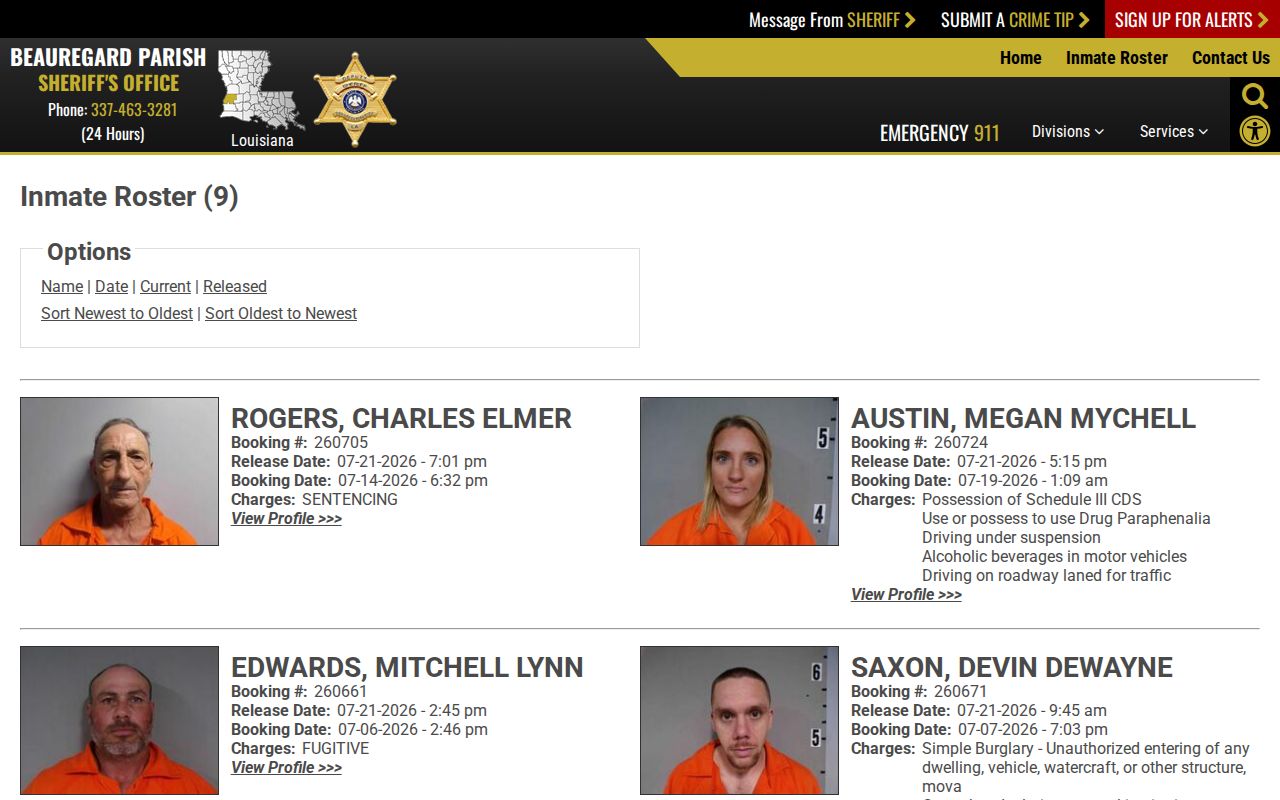
The captured roster illustrates why its precise times are useful and why its missing destination field requires a second check. One observed DOC ID notation also shows that a BPSO release can lead into state custody.
For a tighter same-day view, use the Beauregard 24-Hour Releases method and keep only timestamps from the newest day. That is a subset of the same official 48-hour source, not a separate sheriff feed.
Verify Beauregard Release Outcomes
A parish release event identifies the custody that ended. It does not always identify freedom from all custody. Possible paths include return to the community, transfer to Louisiana DPS&C, an outside parish bed, or pickup by a federal or immigration authority. Ask BPSO whether the listed event was a community release or a transfer and request the receiving authority when releasable.
Start each follow-up at the custody level suggested by the disposition. A DOC transfer belongs in LAVNS and DPS&C records. A move to a neighboring jail belongs in that jail's release log once BPSO names the facility. An immigration pickup belongs with ICE, and a federal sentence belongs with BOP. The court file can explain authority, but the receiving agency controls whether custody continued after the local timestamp.
| Follow-up source | Question answered |
|---|---|
| BPSO jail record | When the parish booking ended and how the disposition was coded. |
| Louisiana VINE or LAVNS | Whether a later local or state custody or supervision event appears. |
| Louisiana DPS&C | Whether the person entered state custody or community supervision. |
| Beauregard court record | Which order, sentence, dismissal, or bond event affected the case. |
| Receiving agency | Whether custody continued after BPSO's release timestamp. |
The BPSO current roster is for active local custody, while its released page is short-lived event data. The LA VINE Beauregard live roster is also a current-custody view, not a release archive. If a person is absent from both, an older release, spelling mismatch, overflow placement, transfer, correction, or nonpublic record remains possible. Absence is not proof.