
Beauregard Parole and Probation
Physical release is not always sentence discharge. Parole permits a sentenced person to serve part of the remaining term in the community after approval by the Louisiana Committee on Parole. Probation is a court-ordered form of community supervision, often imposed instead of all or part of incarceration. Louisiana DPS&C Division of Probation and Parole administers community supervision in both situations, but the source and legal stage differ.
A Beauregard Parish jail card also cannot establish either status by itself. The BPSO released feed shows that a booking moved to the released side of the local system. It does not display a supervision office, transfer destination, or sentence discharge. LAVNS and the DPS&C locator are the better paths when state custody or state supervision follows.
| Point | Parole | Probation |
|---|---|---|
| Who authorizes it | Louisiana Committee on Parole, subject to law and conditions | The sentencing court |
| When it occurs | After a prison term begins and release is approved or allowed | As part of the criminal judgment or later court action |
| Local administrator | DPS&C Probation and Parole | DPS&C Probation and Parole |
| Best public checks | LAVNS, DPS&C locator, parole ruling, assigned office | LAVNS, DPS&C locator, court minutes, assigned office |
| What ends it | Lawful discharge or completion, not mere prison exit | Court or agency termination shown by the controlling record |
- Parole
- Conditional community release from a prison sentence before full-term discharge.
- Probation
- Court-ordered community supervision tied to a judgment.
- Discharge
- The formal end of the relevant custody or supervision term.
- Absconder
- A supervised person alleged to have stopped reporting or left supervision without permission.
Verify Beauregard Post-Release Supervision
Start with identity, not a name alone. Louisiana’s online public route is the Louisiana LAVNS person search. DPS&C says that system includes people in state custody and on probation or parole, with state data updated every 24 hours. That makes it useful after prison release while supervision continues, though it is not a complete archive of every old discharge.
- Search the exact name or known offender identifier, then compare secondary details and the listed agency.
- Read the custody or community-supervision status and save the dated event with the agency name.
- Call the DPS&C Imprisoned Person Locator at 225-383-4580 with a DPS&C number, or a name and date of birth, to ask for the assigned P&P district.
- Contact the assigned district office for appropriate public verification or routing. Do not request confidential case details.
- For probation, compare the result with 36th Judicial District Court minutes showing the sentence, revocation, or termination.
- For parole, review the official docket and ruling, then confirm the later custody change through LAVNS or DPS&C.
A no-result does not clear supervision. Retry spelling and identifiers, check whether another agency holds the record, and seek the existing court or DPS&C record. For the local custody timeline before supervision, the Beauregard Parish released-inmate search explains how the BPSO release record and court file fit together.
Important: A supervision status can show continued state authority after release, but it may not give the original jail exit time.
Note: Record the agency and access date because one custody system’s release does not establish release from every other authority.
Beauregard Supervision Through Leesville
Beauregard Parish has no separately listed P&P district office. The Leesville Probation and Parole office serves Beauregard and Vernon parishes. Its official profile says the district supervises more than 1,100 cases. It is the local verification and routing point after a state release, but it does not decide parole eligibility or grant parole.
Leesville Probation and Parole
201 Murphy Street
Leesville, LA 71446
Mail: P.O. Drawer U, Leesville, LA 71496
337-238-6427
Fax: 337-238-6454
Monday through Friday, 8:00 a.m. to 4:30 p.m.
The office also works with Beauregard Drug Court and provides monthly sex-offender treatment classes within the two-parish district. Those functions show why a court file, supervision record, and registry entry answer different questions. Registry status does not establish a release date, and absence from a registry says nothing about a person who is not subject to that specialized law.
The official Leesville office page provides the best current district details.
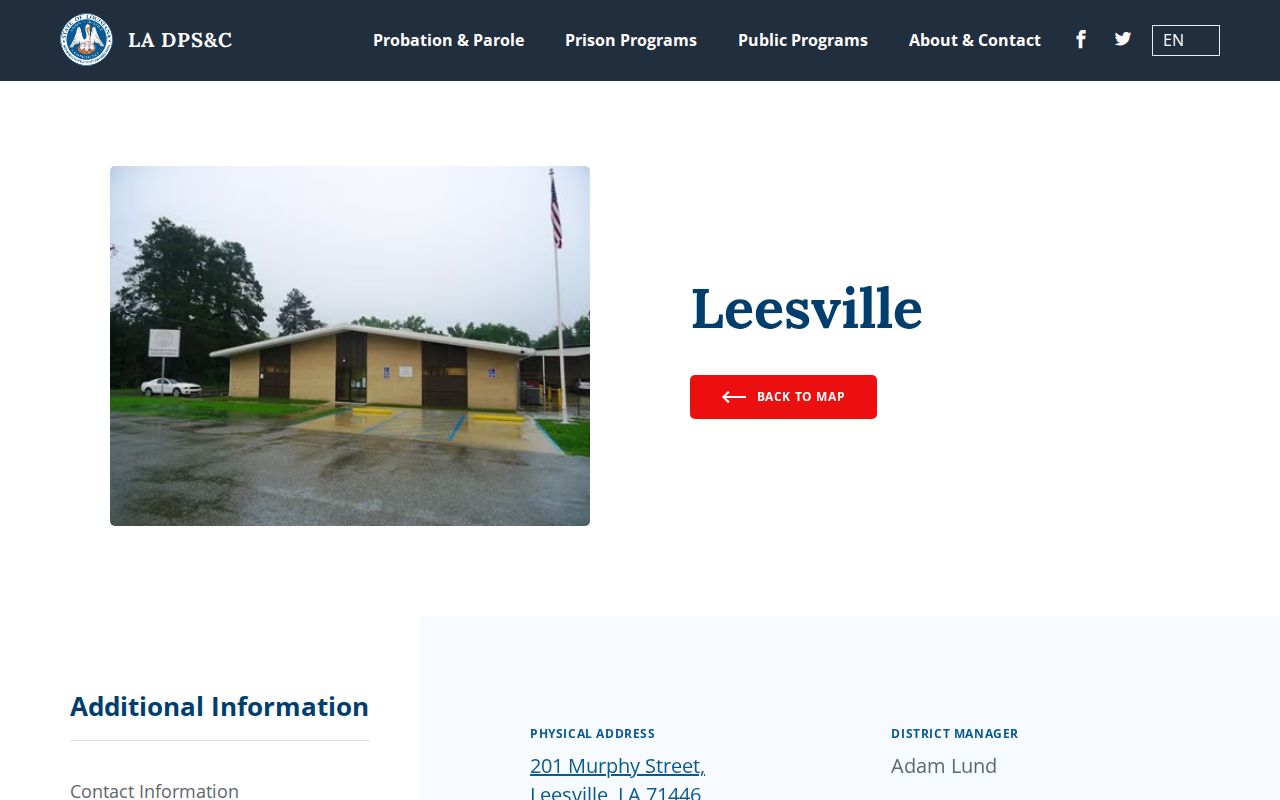
The captured office page helps confirm the correct district before a caller shares limited identifying information for routing.
Beauregard Parole Rulings and Release
The Louisiana Board of Pardons and Committee on Parole publishes public schedules, agendas, and rulings through its parole docket page. Dockets run from 2012 to the present. The published 2026 schedule includes several hearing blocks in many months, often by Zoom, so there is no safe assumption of one fixed monthly meeting.
Search the correct year and month. Match the person, DPS&C number, and facility on the agenda, then open the posted ruling. Use the exact outcome term shown by the Board. A grant means the panel approved parole subject to the lawful process and conditions. It does not prove the person walked out that day. LAVNS, DPS&C, and the assigned supervision office must confirm the later event.
The Board’s parole docket page shows how schedules and results are organized.
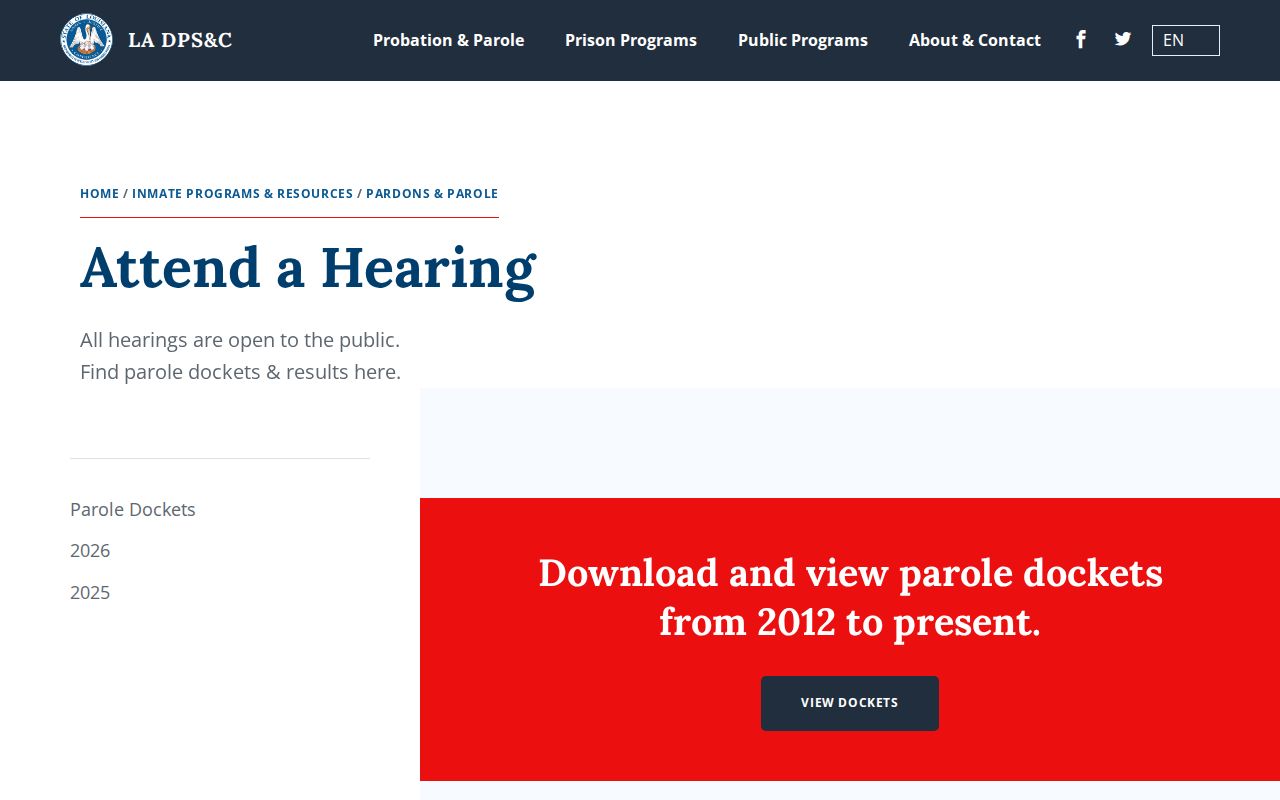
The docket is case-process evidence, while the releasing agency’s record controls the physical custody change.
Eligibility is governed by Louisiana R.S. 15:574.4 and special provisions. Offense date, sentence, prior convictions, classifications, and exclusions matter. DPS&C calculates eligibility. Eligibility permits consideration; it does not guarantee a hearing result or release.
For covered offenses before August 1, 2024, the current statute describes several distinct thresholds. It includes 25% for certain otherwise eligible nonviolent and non-sex cases that are not fourth or subsequent felonies, 65% for specified first violent offenses, and 75% for specified second violent or first or second sex offenses. Some third or subsequent violent or sex cases are ineligible, while specified fourth or subsequent nonviolent cases are described at 65%. These categories are context, not a do-it-yourself calculation. DPS&C must apply the offense date, sentence history, and all exclusions.
Board policy says DPS&C generally compiles material and schedules a public hearing about nine months before eligibility when appropriate. A person can still face a denial, later rehearing, or revocation process. Questions about the Board process may be sent to paroleboard@la.gov. Questions about the assigned supervision office belong with the DPS&C locator and the Leesville district, not the Board.
Note: A reconsideration application may be filed within the Board policy’s 21-day window, but that process is not release confirmation.
Beauregard Supervision Violations and Warrants
Common supervision conditions can concern reporting, travel, treatment, payment obligations set by lawful order, and compliance with other directives. The exact conditions belong to the individual order and supervision record. A suspected breach may lead to investigation, a warrant, detention, a revocation process, or another response. It should not be inferred from a stale web entry.
No official statewide public, name-searchable absconder list was found in the Beauregard research. A person missing from LAVNS is not cleared of a warrant. A booking charge that mentions a bench warrant is also not a live warrant database. For a current question, contact the assigned P&P office, the relevant court clerk, and law enforcement. The Board publishes revocation schedules and dockets, but a hearing listing proves only that a case event was scheduled.
Verify directly: Never treat silence in LAVNS or a past roster entry as current warrant clearance.
Work Release Is Not Discharge
Beauregard has two local arrangements that can be confused with release. Reporting describes BPSO-city supervised inmate work crews and a Southwest Transitional Work Program associated with the former C. Paul Phelps site. Both are custody or program arrangements. A person may work outside a secure building or move into a transitional setting without ending the sentence.
The former C. Paul Phelps prison is closed and is not listed as an active state prison. The current program should not be described as release from that former prison. Confirm a later community release or discharge through DPS&C and LAVNS, then use the assigned P&P office if supervision follows. Likewise, a daily work assignment under BPSO control is not a card on the sheriff’s released roster.
Note: “Work release” describes a custody program here, not proof that all custody or supervision has ended.
How Beauregard Supervision Ends
Supervision ends through the controlling discharge or termination process, not because a person left the jail roster or completed a parole hearing. For probation, court minutes may show termination, revocation, or satisfaction of the court term. For parole or other state supervision, DPS&C records are the controlling source for the state status. Ask for an existing discharge or supervision-history record rather than a new explanation.
A narrow record request should identify the person, DPS&C number when known, supervision district, and relevant date range. Ask for an existing record sufficient to show the start and end of the public supervision status and the date of discharge. Medical, victim, investigative, security, and other protected case details may be withheld. The goal is status verification, not the confidential contents of an officer’s case file.
Louisiana R.S. 44:1 broadly defines public records, subject to legal exceptions, and R.S. 44:31 establishes access rights for adults. Access does not make every supervision field public. If a custodian cannot produce the record at once, R.S. 44:35 uses five business days as a benchmark for a written determination or a reasonable production-time estimate. It does not guarantee full production in that period.
If records conflict, assign each source its proper role. The BPSO record controls when its booking ended. A court order controls the legal action. DPS&C controls its sentence computation and community-supervision record. LAVNS is a useful public transmission, but the releasing or supervising agency’s certified or directly confirmed record prevails. Preserve the conflicting entries and describe the gap instead of forcing one date.