
Beauregard Federal Custody Transfers
No active federal prison, ICE detention center, or USMS facility was verified in Beauregard Parish. No current official Beauregard ICE detention contract was found either. The absence of a local federal building does not settle a named person’s status. BOP, ICE, or USMS can become relevant after an authority picks someone up from the Beauregard Parish Detention Center.
The BPSO rolling released roster can show when its booking ended, but its public card does not visibly display the release reason or destination. A federal or immigration pickup is a transfer, not release from all custody. Call the jail at 337-460-5520 and ask for the releasable disposition or receiving authority tied to the booking. Then move to that authority’s search path.
The Beauregard Parish Detention Center record page covers the local booking step. Federal records begin only when federal authority applies. A DeRidder arrest or 36th Judicial District Court case also does not prove federal custody unless a federal transfer or proceeding is documented.
Custody boundary: A BPSO release timestamp may mark federal or ICE pickup, so confirm the destination before calling it community release.
Search Beauregard Federal Release Records
The Federal Bureau of Prisons Inmate Locator is the correct public search for a person who entered BOP custody. Its records generally cover 1982 to the present. Search by BOP register number, DCDC number, FBI number, INS number, or exact name. Optional age, race, and sex fields can narrow name results. Exact spelling matters.
- First confirm that the Beauregard jail disposition names a federal receiving authority or that a federal case exists.
- Open the official BOP locator and use a known federal identifier when possible.
- If searching by name, enter the exact spelling and add only reliable secondary details.
- Compare the name, register number, age, race, sex, release date, and location.
- Save the result date and the exact status shown by BOP.
- Use BOP records or the federal docket when the public result does not answer the transfer question.
The official BOP locator screen shows the identifier and name search paths.
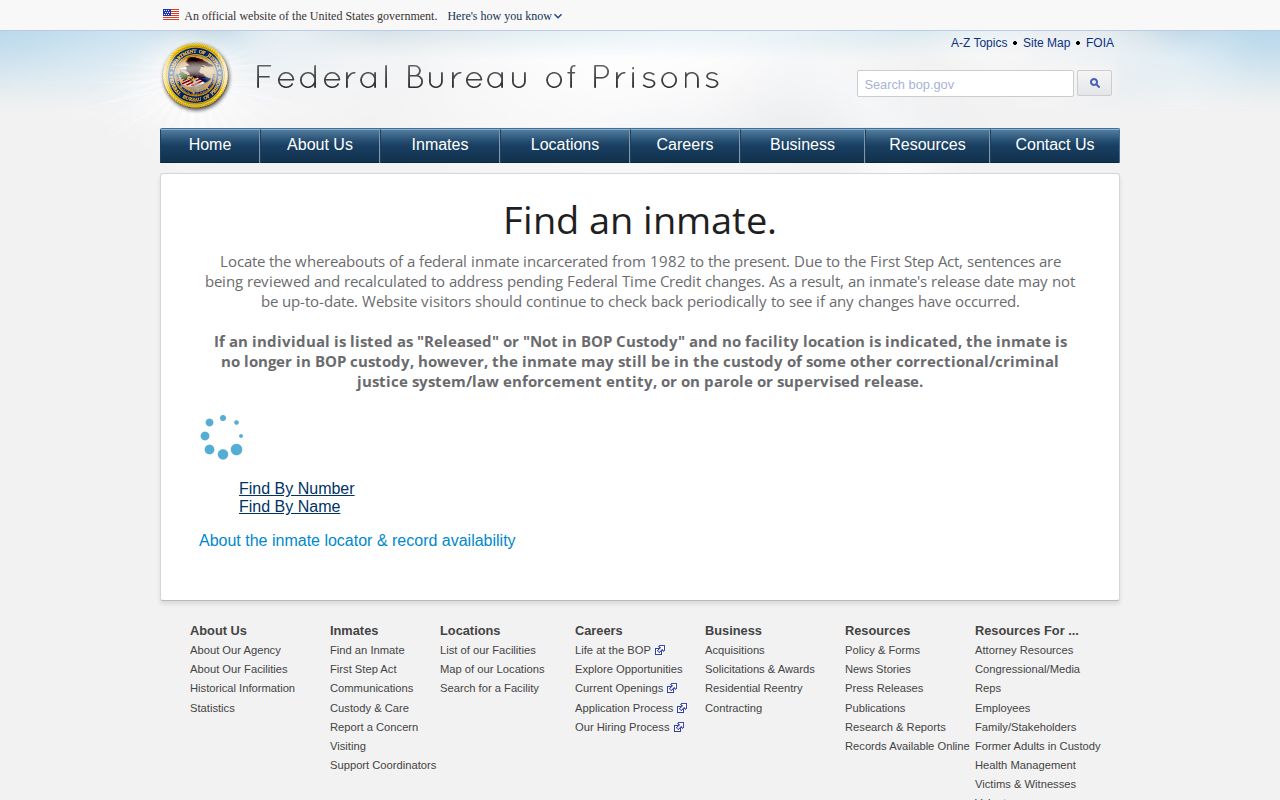
The locator applies to federal BOP custody and should not be used as a substitute for the BPSO or Louisiana DPS&C record.
For custody before 1982, BOP directs historical searches to the National Archives and Records Administration. Provide the person’s identity and an approximate place and time of federal custody. USMS pretrial custody may never produce a BOP result if the person did not enter the federal prison system.
Note: A missing BOP result does not prove that a Beauregard Parish jail release led directly back to the community.
Read BOP Release Results Correctly
BOP defines its own fields. A past release date with no facility location means the person left BOP custody on that date. A result marked “RELEASED” likewise means the person is no longer in BOP custody. Neither statement promises release from every correctional system or freedom from federal supervision. Another state or local authority may still hold the person.
| BOP result | What it means | What to check next |
|---|---|---|
| Past date, no location | Release from BOP custody on the displayed date | Federal supervision and other custody systems |
| RELEASED | No longer in BOP custody | Receiving authority or supervised release |
| Future date | A projected federal release date | Recheck after the date because calculations may change |
| UNKNOWN | The federal term is undetermined | BOP or federal court records |
| IN TRANSIT | Movement may be under USMS control | Federal court and official custody confirmation |
| No match | No result under the submitted search | Identifiers, spelling, USMS, ICE, state, or local custody |
BOP data update daily. First Step Act recalculations can make a displayed future date stale. Record a future date as projected, then confirm the completed release after it passes. A federal court release order may explain the authority for release, but BOP’s event record establishes when BOP custody ended.
The BOP result-definitions page explains the meaning of past dates and status labels.
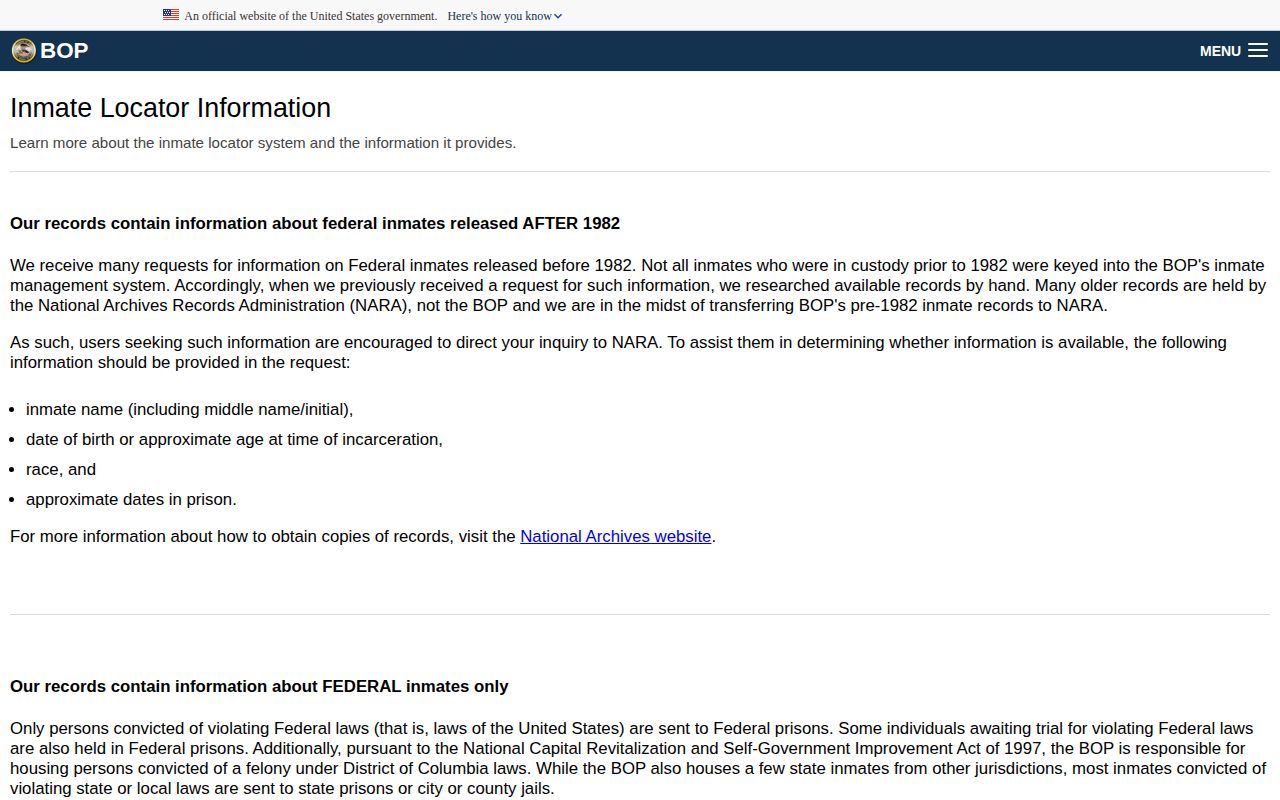
The agency definitions prevent a past federal release from being mistaken for release from all custody or supervision.
Find Beauregard ICE Custody Changes
The ICE Online Detainee Locator System, or ODLS, covers current detainees and people released from ICE custody within the last 60 days. Search by a nine-digit A-number plus country of birth, or by exact first and last name plus country of birth and an optional date of birth. The public system excludes records for people under 18.
ICE’s 60-day released window is not a permanent archive. Record the agency, status, date, and search method while the result is available. If the person does not appear, check the spelling and A-number format. Then contact the Detention Reporting and Information Line at 888-351-4024 for basic case-information help. DRIL operates Monday through Friday from 8:00 a.m. to 8:00 p.m. Eastern, excluding holidays.
ODLS concerns ICE custody only. It does not explain the BPSO booking, the 36th Judicial District Court case, or a BOP sentence. A person can leave BPSO, enter ICE custody, and later leave ICE within separate date ranges. Preserve each agency event as its own fact.
ICE Custody Information
Online Detainee Locator System
DRIL: 888-351-4024
Monday through Friday
8:00 a.m. to 8:00 p.m. Eastern
Closed on federal holidays
Note: Research verified no current Beauregard Parish ICE facility or contract, so no local ICE placement should be presumed.
ICE Detainers After Beauregard Release
An ICE detainer asks another law-enforcement agency to notify ICE before ordinary release and maintain custody for up to 48 additional hours so ICE can assume custody. The key point is the handoff. A person can reach the end of the local basis for detention and still move into ICE custody.
When the BPSO feed shows released, ask whether the disposition was ICE pickup or another transfer. If ICE took custody, check ODLS and use DRIL when the web result is missing or unclear. Do not state that the person returned to the community merely because the local card moved to “Released.” Conversely, an old report showing no ICE count at one point does not prove the parish has never had an ICE transfer.
A detainer is also not the same as a federal criminal sentence. ICE handles immigration custody. BOP handles sentenced federal imprisonment, while USMS often handles federal pretrial and court-related movement. Matching the authority is the first step in choosing the correct locator.
USMS Release Records for Beauregard
The United States Marshals Service handles many federal pretrial and court-related prisoners but offers no public locator equal to BOP’s. Its public-information policy says prisoner information and photographs generally are not released to the public. A lack of a USMS search result therefore cannot be used as proof of release.
Use the federal court docket to find a detention or release order. If the person later entered BOP custody, use the BOP locator and records. An “IN TRANSIT” BOP result may reflect movement under USMS control and does not prove community release. Ask the court or responsible federal custodian for the existing record that answers the exact question.
USMS also is not a public booking-photo source. A BPSO photograph belongs to the parish booking and does not establish the person’s later federal status. Keep the image source, custody episode, and date attached to any record used.
Note: A federal court order explains legal authority, while the custodian’s event record confirms when physical custody changed.
Request Federal and Transfer Records
A records request should name one authority and one custody episode. For BPSO, identify the person, booking number, booking date, and known federal or ICE handoff. Ask for existing records sufficient to show the actual local release date and time, disposition, destination or receiving authority, and release authorization. The local Beauregard Parish release-record search explains the parish request route.
For BOP, use its FOIA process and DOJ-361 when identity verification or consent is required. Request the existing federal admission and release history, release date, releasing institution, and transfer information that can lawfully be disclosed. A broad request for every record is less useful than named fields and a clear date range. For older pre-1982 custody, follow BOP’s route to NARA.
ICE records beyond the short ODLS period may require ICE records channels or immigration case documents. For USMS, use the federal docket for public court orders and request only releasable agency records. Protected, investigative, security, juvenile, medical, and other confidential information may be withheld or redacted.
Louisiana R.S. 44:35 applies to the parish custodian, not federal FOIA deadlines. Its five-business-day benchmark concerns a written determination or reasonable production-time estimate, not guaranteed full production. Ask BPSO to cite the legal basis for a local redaction and identify another custodian when the requested transfer record belongs elsewhere.
Resolve Beauregard Custody Conflicts
Each authority controls its own event. BPSO controls when the parish booking ended. BOP controls federal prison custody. ICE controls immigration custody. USMS and the federal court control their own movement and legal records. Louisiana DPS&C and LAVNS cover state custody and community supervision. A court order can explain why an action was authorized without showing the final processing time.
If BPSO shows release and ODLS shows current ICE custody, describe a parish release followed by immigration custody. If BOP shows a past release date while Louisiana reports current custody, the person left BOP but did not leave all custody. If a federal order says release but the custodian’s record shows a later time, distinguish the legal order from the completed exit.
Save the identifier, agency, date, status wording, and access time for each result. Ask the releasing or receiving agency to correct an apparent error with primary evidence. When a destination cannot be confirmed, state the verified local release and leave the next custody step unresolved rather than guessing.